


From Lead Stabilizers to Ca/Zn Stabilizers: What Should PVC Processors Pay Attention To?
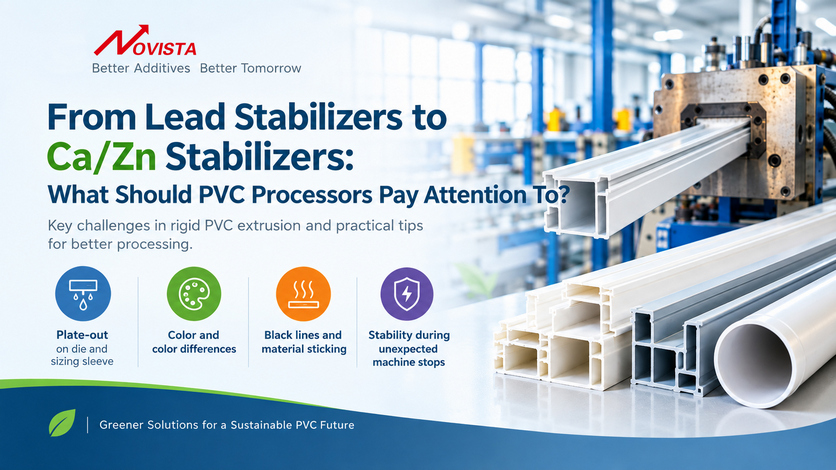
The move from traditional lead stabilizers to environmentally friendly Ca/Zn stabilizers is an important trend in the PVC industry.
However, changing the stabilizer system is not simply a matter of replacing one product with another. In rigid PVC extrusion, such as profiles, pipes, and other hard PVC products, processors may notice some new or more sensitive processing issues.
Based on our experience, there are several points that deserve attention.
Plate-out on the die and sizing sleeve
Plate-out can occur during the extrusion of rigid PVC, especially around the die and sizing sleeve.
One common type is a white, yellow, or brown wax-like deposit on the die. This is often related to excessive low-melting lubricant or poor compatibility between the lubricant and PVC. When the lubricant moves toward the surface of the material, it can separate from the profile at the die exit and gradually build up on the die.
Another type is the long, thin deposit sometimes called a “whisker” or “mustache” on the die. The reason can be more complicated. Poor late-stage lubrication, insufficient melt strength, or poor demolding can all contribute to this problem.
Therefore, more lubricant is not always the answer. In many cases, it is better to use a more efficient, high-melting external lubricant and keep the total lubricant level as low as possible while still meeting the processing requirements.
Color and color differences
Color control is another common challenge when moving from lead stabilizers to Ca/Zn systems.
After changing the stabilizer system, the PVC product may show a different color tone. A slightly blue or greenish tone is quite common, while moving the color back toward a warmer or redder tone can be more difficult.
Sometimes the outside and inside of the profile may also have different colors. The outside may look normal, while the inside appears more blue or yellow.
Another issue is color drift during production. With lead stabilizers, there can also be some color differences between different machines or different production periods, but the variation is often relatively small. With Ca/Zn systems, the color may be more sensitive to small changes in raw materials and processing conditions.
Temperature, pressure, residence time and other processing conditions can all influence the final color.
This is partly because Ca/Zn stabilizers are usually multi-component systems. Different components work together during different stages of processing, so the balance between these components is very important.
Black lines and material sticking
Burning, black lines, or material sticking around the die are also problems that PVC processors need to watch carefully.
The basic reason is usually local thermal degradation of the PVC material. But the actual cause can be different from one production line to another.
It may be related to insufficient thermal stability, insufficient lubrication, poor lubricant dispersion, low melt strength, an unsuitable die design, too many sharp corners, or even impurities and coarse particles in the filler.
This is why simply adding more stabilizer does not always solve the problem.
For example, if the problem is caused by insufficient thermal stability, increasing the stabilization level may help. But if the real problem is poor lubrication or poor dispersion, the solution should focus on the lubrication system rather than simply adding more stabilizer.
The key is to identify the actual cause before changing the formulation.
Stability during unexpected machine stops
Normal production is not the only situation that tests a stabilizer.
In real industrial production, unexpected power failures, machine stops, or other interruptions can happen at any time. When the machine stops, PVC material may remain inside the barrel for a long period.
This is a test of the static thermal stability of the material.
If the stability is not sufficient, the material may start to degrade, burn, or even cause serious damage to the screw and barrel.
Compared with traditional lead stabilizers, Ca/Zn systems can require more attention to static stability and shutdown conditions.
For this reason, it is important to keep a reasonable safety margin in the stabilizer dosage, use suitable start-up/shutdown material when possible, and select a Ca/Zn stabilizer that considers both normal processing and unexpected production conditions.
The key message
Moving to Ca/Zn stabilizers is not only about replacing lead with a more environmentally friendly stabilization system.
It is about understanding the new balance between thermal stability, lubrication, melt strength, demolding, color control, processing conditions and equipment design.
A good Ca/Zn stabilizer should not only perform well under ideal production conditions. It should also provide enough processing tolerance when raw materials, temperature, pressure or production conditions change slightly.
For PVC processors, the goal is not simply to find a stabilizer that works.
The goal is to find a well-balanced stabilization system that works consistently in real production.