


Lubricants and Plasticization in PVC Processing: How to Find the Right Balance
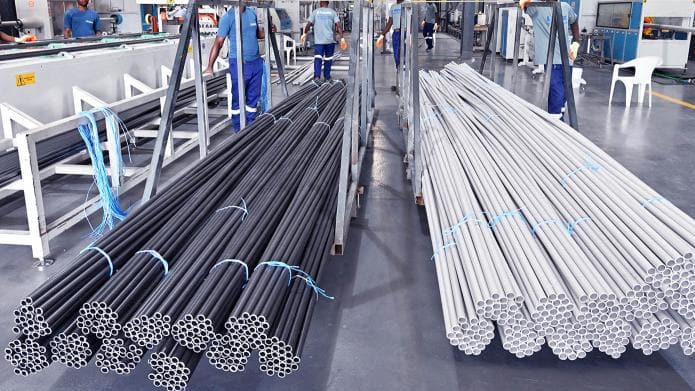
In PVC processing, the right lubricant system and proper plasticization are two of the most important factors for producing high-quality products and maintaining stable production.
Finding the right balance between internal lubricants and external lubricants can improve product appearance, processing efficiency, and overall production stability.
1. How Internal and External Lubricants Work Together
Internal Lubricants
Examples: Stearic acid, GMS (Glycerol Monostearate)
Internal lubricants work inside the PVC melt. They reduce friction between PVC molecular chains, speed up plasticization, and improve melt flow.
External Lubricants
Examples: Paraffin wax, PE wax
External lubricants form a thin layer between the PVC melt and the metal surface of the processing equipment. They reduce friction, prevent sticking, and slow down plasticization when necessary.
2. How to Adjust the Lubricant System
If Plasticization Is Too High
Symptoms may include yellowing, material degradation, or unstable processing.
Possible solutions:
Increase external lubricant by about 0.1–0.3 phr.
Reduce the amount of internal lubricant.
If Plasticization Is Too Low
Symptoms may include poor melt flow, rough surface, or unmelted particles.
Possible solutions:
Increase internal lubricant, such as 0.2–0.5 phr calcium stearate.
Add an ACR processing aid to improve fusion and melt strength.
Consider the Processing Temperature
High-temperature production
Choose heat-resistant external lubricants, such as oxidized PE wax, to maintain lubrication performance.
Low-temperature production
Increase the proportion of internal lubricant.
Use ACR processing aid to improve melt strength.
3. Common Processing Problems and Solutions
Rough pipe surface
Possible cause:
Not enough external lubricant.
Solution:
Increase paraffin wax.
Poor melt flow
Possible cause:
Insufficient internal lubricant.
Solution:
Add calcium stearate.
Lubricant blooming on the product surface
Possible cause:
Too much external lubricant.
Solution:
Reduce the dosage or use a more compatible lubricant such as EBS.
4. Five Ways to Check the Plasticization Condition
1. Observe the Melt
A well-plasticized PVC melt should be smooth, uniform, and free of unmelted particles.
Warning signs:
Rough surface → Under-plasticization
Yellow or brittle melt → Over-plasticization
2. Use a Torque Rheometer
The torque rheometer provides valuable information about fusion behavior.
If the fusion time is too short, increase external lubricant to slow down plasticization.
If the equilibrium torque is too high, there may be insufficient internal lubricant or excessive filler.
3. Check the Product Surface
Common defects include:
Low gloss or flow marks → Poor lubrication or uneven plasticization.
Bubbles or yellow streaks → Over-plasticization and possible thermal degradation.
4. Monitor Processing Data
Motor current
High current may indicate excessive plasticization.
Low current may indicate insufficient plasticization.
Melt pressure
Large pressure fluctuations often suggest an unbalanced lubricant system.
5. Laboratory Testing
DSC (Differential Scanning Calorimetry)
Used to evaluate the degree of plasticization by analyzing melting behavior.
Yellowing Index Test
Helps determine whether thermal degradation has occurred due to over-plasticization.
5. Practical Tips
Keep the total lubricant dosage between 1–3 phr. Excessive lubricant may cause blooming or reduce mechanical properties.
Remember that lead stabilizers and calcium-zinc stabilizers also provide some lubrication. Their effect should be considered when designing the formulation.
Make small adjustments. It is recommended to change the dosage by no more than 0.2 phr each time and observe the results before making further changes.
Adjust the formulation according to the season. More external lubricant is often needed in hot weather, while more internal lubricant may be beneficial in cold conditions.
Conclusion
PVC processing is all about balancing lubrication and plasticization.
By understanding the functions of internal and external lubricants, monitoring plasticization carefully, and making small formulation adjustments, manufacturers can reduce processing defects, improve product quality, and achieve more stable production.
Sometimes, a small change in the lubricant system can make a big difference in processing performance.