


Common Problems and Solutions in PVC Edge Banding Production
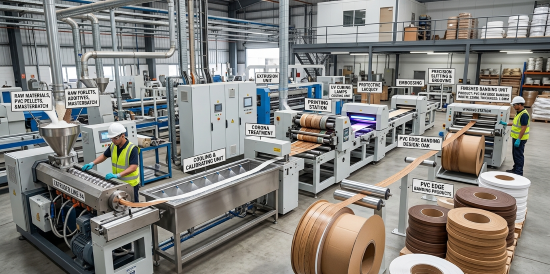
PVC edge banding may encounter different quality problems during production. Below are some common issues, their main causes, and practical solutions.
1. Burrs or Rough Edges on the Product
The main reason is usually burnt residue remaining inside the mold, which has not been cleaned for a long time.
Solution
Clean the mold thoroughly before restarting production.
2. Poor Toughness of the Edge Banding
This problem is mainly caused by insufficient CPE addition or poor-quality CPE.
Solution
Increase the CPE dosage appropriately or replace it with higher-quality CPE.
3. Whitening During Trimming or Cutting
(Usually happens in 3:2 and 1:1 formulations)
Solutions
3.1. Increase the amount of color pigment.
First adjust the base color with titanium dioxide, then increase the pigment dosage.
3.2. Use high-quality PE wax to improve surface gloss.
3.3. Increase the extrusion temperature or reduce the extrusion speed to improve plasticization.
Better plasticization generally gives better performance.
4. Pinholes, Surface Dots, or Bubbles on the Finished Product
These problems are mainly caused by improper operation during production.
Possible Causes and Solutions
1) Improper mixing temperature
For example:
* Mixing temperature for 3:2 formulations: around 140°C
* Mixing temperature for 2:1 formulations: around 135°C
Incorrect mixing temperatures may lead to bubbles and pinholes.
2) Contamination during mixing
If packaging bags or mixing tank covers are not cleaned properly, raw powder or impurities may enter the material.
3) Pigments not mixed evenly
Uneven pigment dispersion can also cause surface defects.
4) Damaged screen mesh
Large calcium carbonate particles may enter the formulation if the screen mesh is damaged.
It is recommended to use an 80–120 mesh screen during production to increase pressure and filter out coarse impurities.
When the cross-section of the material appears very glossy, it usually indicates over-plasticization. In this case, additional calcium carbonate can be added and the material can be re-pelletized.
For 1:1 formulations, the screen mesh should normally be replaced after every two batches. Otherwise, uneven color, pinholes, and surface dots may appear.
How to Check Calcium Carbonate Quality
Use a 200-mesh screen to sieve 500g of calcium carbonate powder, then rinse it with clean water.
Large particles and impurities will become visible.
5. Screen Blockage During Production
The main reason is excessive moisture in the calcium carbonate powder.
Solution
First heat and mix the calcium carbonate to around 100°C to fully remove moisture, then add PVC resin for mixing.
In addition, some low-quality CPE contains coarse calcium particles that cannot plasticize properly during production, which may also cause screen blockage.
Possible solutions:
* Replace the CPE with better-quality material
* Improve PVC plasticization so the coarse particles can be properly processed
6. Product Discoloration
Possible Causes and Solutions
1) Poor-quality stabilizer or insufficient dosage
Increase the stabilizer dosage by 100–200g.
If the problem remains, replace the stabilizer with a better one.
However, excessive lubricants may reduce toughness.
Too much stearic acid or PE wax may cause:
* Surface blooming
* Poor printability
* Reduced toughness
2) Mixing temperature too low
If the mixing temperature is below the required level, the toughness of the final product will decrease significantly.
7. Inconsistent Width of Edge Banding
(Uneven Width or "Big-Small Edge" Problem)
This problem is usually caused by uneven mixing, inaccurate temperature readings, or inconsistent worker operation.
Solution
* Ensure uniform mixing
* Regularly check temperature controllers and sensors
* Standardize operating procedures for workers
PVC edge banding production requires stable raw material quality, proper formulation design, and standardized processing control.
Careful attention to mixing, plasticization, temperature control, and material cleanliness can significantly improve product quality and production stability.