


Switching from Lead to Calcium-Zinc Stabilizers in Rigid PVC: 4 Common Problems and How to Handle Them
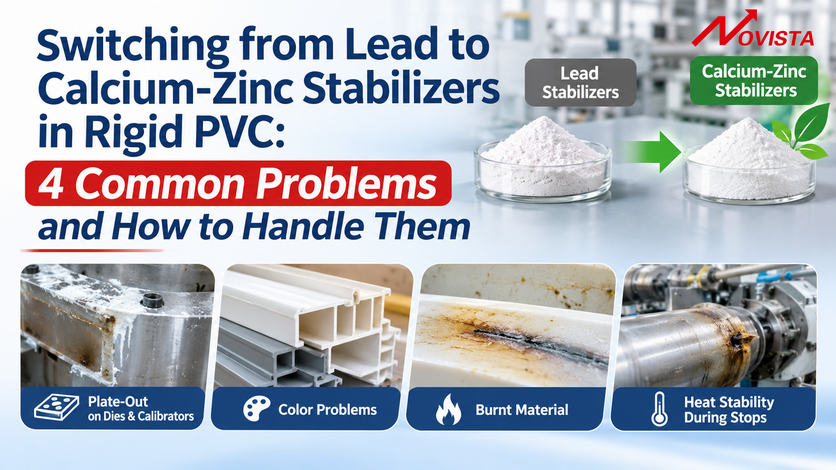
Moving from lead-based stabilizers to eco-friendly calcium-zinc (Ca-Zn) stabilizers is the trend in rigid PVC. But in real production, many factories find that new problems appear, or old problems become harder to solve. Here are four of the most common ones.
1. Plate-Out (Build-Up on Dies and Sizing Sleeves)
Plate-out happens with lead stabilizers too, but it shows up more often with Ca-Zn, and the causes are more complicated. It mainly appears on the die and the calibrator (sizing sleeve).
On the die, there are two typical cases:
(a) White or yellow wax or oil on the die. The cause is fairly clear. There is too much low-melting-point lubricant that does not mix well with PVC. It moves to the surface of the product, and when the product leaves the die, it stays behind and builds up as a waxy or oily layer.
(b) "Whiskers" that keep growing on the die. The cause is more complex. We believe the lubrication in the later stage of processing is not enough, so the melt is not strong enough and does not release well from the die.
On the calibrator, plate-out is more common with Ca-Zn stabilizers. The causes are complicated and not fully understood yet, so a complete fix is hard.
What you can try:
- Use an efficient, high-melting-point external lubricant.
- Use as little lubricant as possible (both internal and external), as long as processing still works.
- Pay attention to melt strength and mold release.
2. Color Problems
After switching from lead to Ca-Zn, color problems are common, take many forms, and are hard to fix. Here are the main ones:
(1) Color shift after changing stabilizer. Products often look bluish or greenish compared with lead-stabilized ones, and it is hard to move the color back toward red.
(2) Different color inside and outside. The outside looks right, but the inside tends to look blue or yellow. This happens often in profiles and sometimes in pipes.
(3) Color drift during production. With lead stabilizers, color also varies a little between machines or between different times on the same machine, but the range is small. With Ca-Zn, the swings can be larger, and small changes in raw materials or process settings have a bigger effect on color. In one case of pipe and fitting production, changes in pressure affected not only the color but also the product's performance, and much more strongly than with lead.
(4) Color change during storage, transport and use. Lead-stabilized rigid PVC products change very little in color over time. With Ca-Zn, products may turn yellow or blue after sitting for a while. If the calcium carbonate filler contains a lot of iron, some products may even turn reddish.
Why does this happen? A Ca-Zn stabilizer is a mix of several materials. Heat stability in the early, middle and late stages of processing comes from these materials working together, and each one affects color a little. With so many components, there are many possible combinations and results.
3. Burnt Material (Degraded Material Sticking in the Die)
This is another common problem. It usually starts with material sticking at corners of the die or mandrel, then becomes yellow or black lines on the product surface. In the worst case, burnt material blocks the die and the line has to stop.
Burnt material always comes from local thermal decomposition, but the reasons behind it vary, so you cannot treat every case the same way. You need to look at what is actually happening, find the real cause, and then fix that cause.
- If the problem is not enough stability, adding stabilizer will solve it.
- If the problem is not enough late-stage lubrication, or poor dispersion of the lubricant, material sticks and burns, and adding more stabilizer will not help. You need to improve the lubrication or its dispersion.
- Other possible causes include low melt strength (material clings to the die wall), too many sharp or rough corners in the die design, and impurities or coarse particles in the filler.
Burnt material is not new with Ca-Zn. It has always existed. The experience we gained from solving it with lead stabilizers still applies once you understand how Ca-Zn stabilizers really behave.
4. Heat Stability When Production Stops Unexpectedly
Unexpected events happen in factories. In PVC processing, the most common are sudden power cuts or emergency stops. These test the material's static stability, meaning how long it can sit in the machine without breaking down. If static stability is poor, material left in the machine too long will decompose and burn. At best, you get more scrap. At worst, you damage the equipment. If burnt material gets stuck in the barrel after a poorly handled stop, the screw and barrel may be scrapped completely.
Ca-Zn stabilizers are generally a bit weaker than lead in static stability, so you need to be better prepared. Here are three suggestions:
- Keep a safety margin in the stabilizer dosage, so the material stays stable when the machine sits idle.
- Use start-up/shut-down compound where possible, so normal production material does not stay in the machine for long.
- Choose a Ca-Zn stabilizer with good static stability, instead of just chasing the lowest price.
Final Thought
Ca-Zn stabilizers are not "worse" than lead. They work differently. Once you understand how they behave, and match the right lubricant system, process and filler to them, most of these problems can be solved.