


Screw Not Feeding? Check These 4 Things Before You Grab a Steel Rod
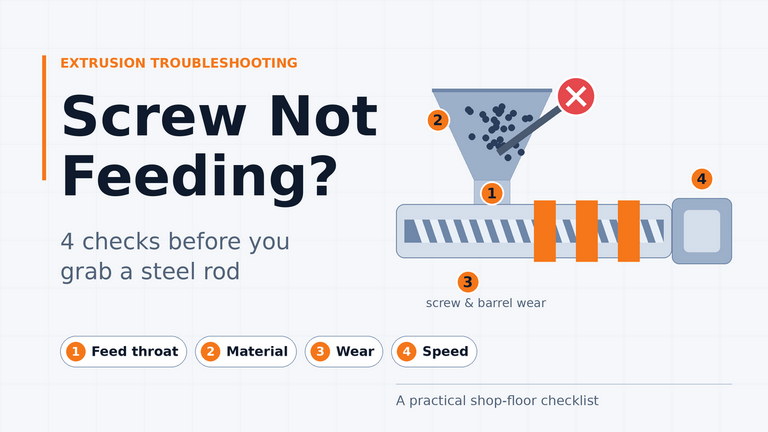
If you run an extruder, you know this one. The line is running fine, then the material stops dropping from the hopper. The motor keeps turning, the amps fall, and output goes to zero.
Most people reach for a steel rod and poke the hopper. It helps for a minute, then the problem comes back. And if that rod ever gets pulled into the screw, you're buying a new screw.
Here is the order I would check things in.
The feed throat
Most sudden feeding problems come from here. If the cooling water is weak or blocked, heat travels up the barrel and softens the pellets before they reach the screw. They stick together and bridge over the opening.
Put your hand on the feed throat. If it's hot, or you see melted plastic inside, that's your answer. Increase the cooling water flow, and on startup, set Zone 1 lower so the screw can grip the pellets while they're still cold and solid.
The material itself
A screw moves solids by friction. The barrel wall has to grip the material more than the screw does. If that balance breaks, the screw just spins.
Too much external lubricant (stearic acid, EBS, white oil) is a common cause in filled and modified compounds. The material slides on the barrel wall and the screw can't bite. Cut back the lubricant, or let the powder absorb it fully before feeding.
Light, fluffy material is the other one. Regrind, film scrap and fine powder often won't fall on their own. A side feeder, a stuffing screw, or a vibrator on the hopper will do more than any amount of poking. Also watch for wet material, since steam pushing up from the barrel can block the throat, and for regrind with big chunks mixed in.
Wear
If the formula and material haven't changed but the machine slips more each month, suspect the hardware. A worn feed section lets material flow backward instead of forward. Long runs of glass-filled or calcium-filled compounds also make the screw channel shallower, and that can cut feeding capacity in half.
A lower feed section temperature or slightly higher back pressure can buy you some time. The real fix is to rebuild the screw or replace the barrel liner. Running with too much clearance just wastes power and material.
Screw and feeder speed
On twin-screw lines, feeding problems are often a speed mismatch. Too much feed overloads the feed section and the material jams at the vent or the opening. A feeder that is too fast for a slow screw packs the channel solid. A screw that is too fast for the feeder leaves the channel half empty.
Go slow to fast. Hold the screw speed steady, raise the feed rate gradually, and watch the amps until the current settles.
The short version
Is the feed throat cool?
Is the material bridging, floating or too slippery?
Is steam pushing the material back?
Are the feeder and screw speeds matched?
Work through these four before you touch the rod.
How NOVISTA can help
As a PVC additive supplier, NOVISTA does more than provide additives that meet your requirements. We can also visit your plant to help with machine setup and trial runs, and guide you on optimizing your production formulation.
Feel free to contact us.